Note: This article focuses on Inuit people who lived traditionally, before the beginning of the 20th century

The Inuit are indigenous people living in the arctic regions of North America, sharing cultural similarities and a common ethnic origin. The Inuit do not worship any gods.
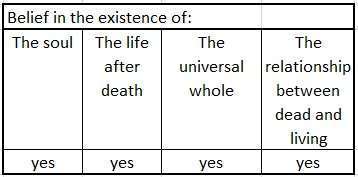
This community has a natural approach and believes, in particular, in a “Mother Earth”. The earth, the sea, the plants, and the animals are all part of the divine, belong to the whole, and live in brotherhood with all living beings. In their minds dying is just a crossing from the physical world toward the spiritual world. They also believe that every being, whether human, animal, or vegetable, has a soul or a breath that lasts after death.


A subterranean world lives under the earth and the sea searching for purification. After this expiation stage, they may travel to the Land of the Moon to find peace and eternal rest. All those who have lived a pure life or have already purified themselves can enter that Land of the Moon. The others continue their reincarnations cycle on Earth.
The Inuit consider that every human being consists of a physical body, a soul (a shadow having a reduced shape of the body), and a name. The living human body is composed of breath and vitality.
When death occurs, the body gives up its breath and vitality. After death, all body’s components break up. The body himself decomposes, the soul leaves to join the land of the dead, the name is transmitted to another person, while the breath returns to the Silla.
Silla represents the universe, an invisible force shared between all living beings, the primordial element of all that exists, the breath of life, and the essence of all movement. Silla controls everything that happens in an individual’s life.
The Inuit suffering from disease are isolated, with some food, into a small snow house or a hut. They cope with death without fear or resistance, with courage. When the end is close, friends and family stop visiting them, and they are facing death alone.
The custom of sick isolation preserves the belongings from destruction, because if someone dies inside the family hut, everything has to be destroyed or thrown away. The relatives empties the dead’s house and purifies it through the cleaning and fumigation processes.
When a death is proclaimed, they fall to the ground and weep, as part of a traditional, solemn, mourning ritual. The family members are exclusively allowed to touch the body.


People from the whole village come and drop down, around the dead body, everyday life objects which could be useful to the deceased in the other world: hunting weapons or fishing utensils for men, or sewing needles for the women.
The man’s body is accompanied by his clothes and his hunter-fisherman’s devices. The woman is surrounded by the sewing instruments, the pots, the lamps, knives and some objects she loved when alive.
The objects surrounding the deceased and the tomb are treated with great respect and are not removed as long as the identity of the grave’s owner is known.

The corpse is kept overnight in the snow house, wrapped in a shroud of animal skin (usually from a seal) and leather thongs (to force his spirit to stay with the body until he arrives at the final burial place). The placement of the deceased’s feet varies according to age.
To not bring bad luck to the hunters, the nearest relatives remove the deceased through a pierced wall in front or the back of the house. They avoid using a sledge, as it must remain with the deceased. Also, the dogs are never allowed to draw a sledge in that situation. Afterwards the body is placed on a hilltop, at the bottom of a cave, or behind his house. The cold from the outside ensures its perfect preservation.
A predominant part of the Inuit buries their dead under a pile of stones. Sometimes they may lay the body outside to be eaten by the birds. The Inuit descending from Asia used to burn their dead, and those from the east side of Greenland used to send them to the sea.
After returning from the burial, the relatives go back inside the hut for three days to mourn the loss of the deceased.
During that period, they are not allowed to dress their hair and have their nostrils covered with a fragment of deerskin. If the death occurred inside the hut, they leave it forever.

The mourning period lasts five days. During those five days, it is mandatory to respect all the rituals. That guarantees the deceased a safe passage between the worlds. If the family does not respect the deceased’s wishes or transgresses the social rules, some souls may become evil spirits that roam the communities and sow disease and suffering.
For three or four days, the dwellers of the village don’t use their dogs, the women stop all kinds of work, and at least for a day, the men are not allowed to go hunting. From the second day following the burial, and until the sixth, men can hunt, but without dogs or sledges, traveling on foot and dragging the hunting back themselves.
Thereafter, the relatives return to the grave, bringing offerings of food and talking to the dead, circling the tomb as the sun makes its course. Each year, and whenever their travels take them that way, they visit the grave, bringing food as an offering to the departed.
Certain food items are not allowed during the mourning period. Sometimes, some community members must carry weapons in case of an encounter with an evil spirit. In sign of mourning during one year they can’t join in any festival and are not allowed to sing certain songs.
It is forbidden to pronounce his name until it is given again to an unborn child. Therefore the deceased continues to live at the same time, through the living beings and within the other worlds.
A child may receive multiple names, often taken from relatives who passed away before or after the child’s birth. This represents a way to transmit values, characteristics, and destinies. Thereby that allows the deceased to revive, symbolically, even after their death.
To protect an unhealthy, the angakuq (the medicine man) is permitted to change a person’s name or dedicate them to Sedna as a symbolic dog, conferring upon them a dog’s name and requiring them to wear a harness beneath their clothing for the rest of their life.

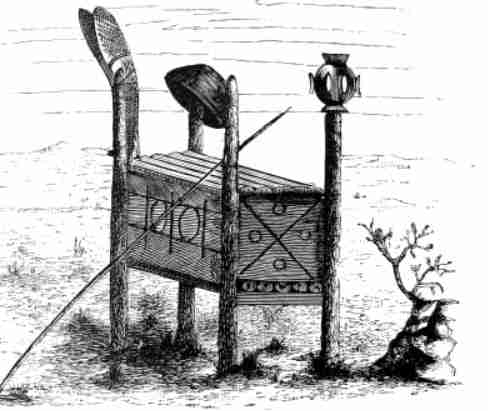
Inuit elders do not fear death because, in their minds, dying is not an end. When an old woman has lost her teeth from working the sealskins too much, when an old man has become too weak to hunt, when the men and women become a burden for their community, they « go on the ice”.
From some points of view, their departure is a sacrifice for the rest of their family: they let themselves be caught by the biting cold and thus die.
That is called institutional suicide.
From another perspective, let’s try to understand the Inuit thought that preaches the search for a quick and dignified death.
For the Inuit, the moral behavior of the deceased and the way to die, determine the soul’s journey in the afterlife. A slow death delays the soul on its way to the afterlife, while a quick death, however violent, allows the soul to leave the body quickly and go straight to The Land of the Moon.
They believe that an elder can decide to shorten the last period of his life rather than wait for a natural death. He can choose when and how to die. For the elder Inuit, euthanasia or abandonment is an individual choice.
Everyone is free to decide if he wants to end his life quickly and continue his journey toward the afterlife.


In « White Lies about the Inuit », John Steckley says:
“The first error was to interpret elder euthanasia in cases of extreme bad health as abandonment for the good of the group over that of the individual.
The second error was in perceiving this rare practice as common…
The third mistake was in construing elder abandonment as permanent and necessarily fatal when the intention was temporary, with hopes of rescue. »
Sources :
Jean Pierre Mohen, Les rites de l’au-delà, Ed. Odile Jacob, 2010
Les rites funéraires des Inuits, (https://www.dansnoscoeurs.fr)
Daniel Pouget, Rites funéraires (https://www.lavanaude.org)
A la découverte de l’Arctique – par Arctik Solo (http://projet-arctique)
Frédéric Laugrand, Lorsque des aînés évoquent la beauté de l’au-delà… ou ce que disent les expériences de mort imminente chez les Inuits du Nunavut (https://www.erudit.org)
Knud Rasmussen, Observations on the Intellectual Culture of the Caribou Eskimos, Forgotten Books, 2018
Les métamorphoses de SILA : mythologie et chamanisme des Inuits (https://agoras.typepad.fr)
Knud Rasmussen, The Netsilik Eskimos: Social Life and Spiritual Culture, Copenhagen : Gyldendal, 1931
Wikipedia, Inuits (https://fr.wikipedia.org/wiki/Inuits)
Traditional Inuit and Their Perception of Death (https://www.deathaspect.org)
Wikipedia, Silap Inua (https://fr.wikipedia.org)
Franz Boas, The Central Eskimo, The Project Gutenberg eBook, eBook #42084 (https://gutenberg.org)
Jean L. Briggs, Never in Anger: Portrait of an Eskimo Family, Harvard University Press, 1970
Gwen K. Healey, Inuit family understandings of sexual health and relationships in Nunavut, (2014)
Diamond Jenness, The Life of the Copper Eskimos (1922) (https://archive.org)